Policy Brief: Hidden ICE-Run Immigration Courts Threaten Due Process
Contact: Greg Chen (GChen@aila.org); Hunter Hammill at (HHammill@aila.org)
In September, the Executive Office for Immigration Review (EOIR) began scheduling hearings in spaces not traditionally used as in-person immigration courts, including facilities run by Immigration and Customs Enforcement (ICE) officers. People are receiving late or no notice of the changes in locations to these new facilities. Some are not even marked as courts, making it difficult for people to find their hearing locations. ICE is denying court observers—including members of Congress and their staff—access to these hearing locations in violation of law.
The sudden use of these unannounced courts is compromising the courts’ integrity and eroding the public’s faith in them as impartial, transparent, and fair institutions. When viewed in context with other dramatic policy changes, these Department of Homeland Security (DHS)-run courts are part of a systematic attack on due process that is transforming the courts into cogs in the enforcement machine.
Americans expect courts to protect the fundamental norms of fairness—including basic functions such as being informed of when and where to appear for your day in court. AILA urges the Administration to stop the use of these unmarked DHS sites and to consider other solutions that will improve court efficiency and fairness. Meanwhile, Congress should enact deeper structural reform, specifically by passing the Real Courts, Rule of Law Act, which creates an independent immigration court. AILA offers additional recommendations at the conclusion of this brief.
ICE Blocks Access to the New Hidden Court
Central to the U.S. judicial system is the requirement that the court provide adequate notice to the parties so they know where to appear for their day in court. To start proceedings, DHS must file a “Notice to Appear” with the immigration court and serve the notice to the individual. The notice informs the person of why the government believes they should be removed from the United States and the time and place of their hearing. The government must also advise people of changes in date or location for future hearings. If someone fails to appear in court, the judge may order them removed in their absence.
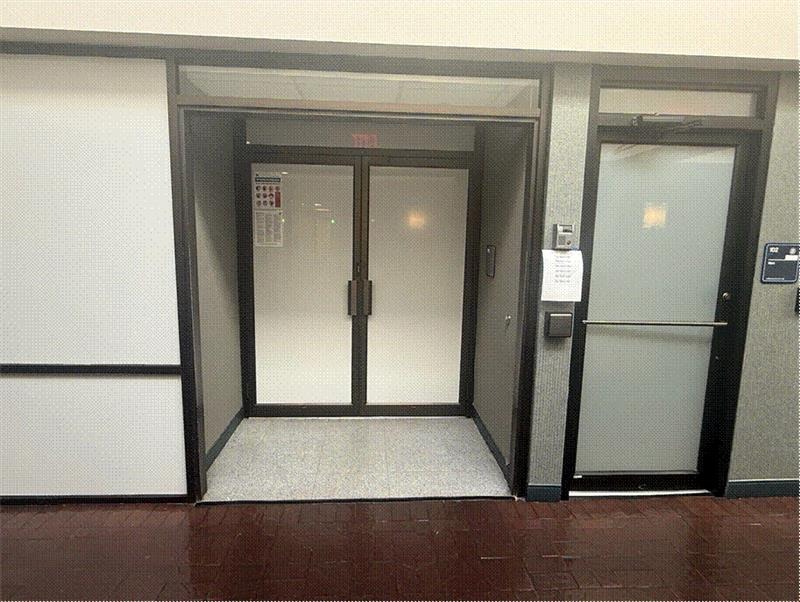 |
| Hallway entrance to the location at the FEMA facility being used for immigration court hearings. Note the lack of identifying court signs. |
People are now receiving last-minute notices redirecting them to DHS-controlled sites for court hearings at Federal Emergency Management Agency (FEMA) headquarters in Washington, D.C., the federal building at 26 Federal Plaza in New York City, and in Los Angeles. Additional new locations are being considered in Chicago, Denver, Miami, and San Antonio. None of these facilities are currently listed on the EOIR website as immigration courts. In some cases, people did not receive any notice of the change in location.
At some of these buildings, there is no signage or other indication that the space functions as an immigration court, such as a list of hearings typically posted outside courtrooms. At the FEMA location, the physical address listed requires people to enter the building lobby through a McDonald’s. Nothing says an immigration court is in the building.
In New York City, the immigration court has operated for years at 26 Federal Plaza on the 12th floor. Now, people are being directed to hearings on the 3rd floor that is controlled by ICE. Staff in the building give people handwritten Post-it notes saying their hearings were moved to the 3rd floor.
Apparent Targeting of Unrepresented People for New Locations
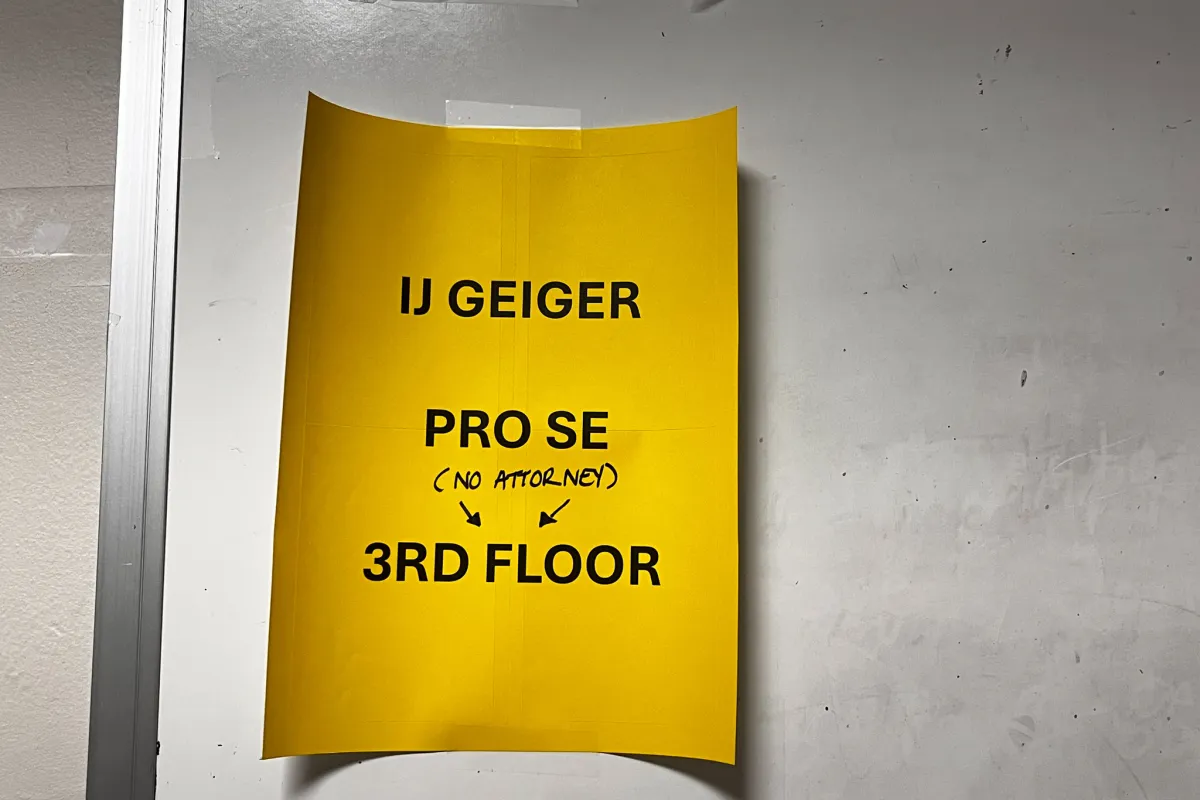 |
| A sign at 26 Federal Plaza in New York City directs pro se individuals to the 3rd floor for their hearings. September 21, 2026. Credit: Gwynne Hogan/The City Reporter |
Particularly troubling, these locations are primarily being used for people who do not have legal counsel. Evidence of this has come from attorneys who report that they entered appearances for clients who have cases assigned at the FEMA and 26 Federal Plaza locations, only to have their cases suddenly reassigned to another court. At 26 Federal Plaza, a paper sign taped to the wall specifically indicates the hearings on the 3rd floor are intended for "pro se (no attorney)" cases. So far, observers who gained access to these hearings have seen only people without legal counsel appear, and many have been ordered removed if they fail to appear. As described below, these courts severely curtail due process and operate out of the public eye in a setting designed to expedite deportations of the most vulnerable people who have no legal counsel.
Notice Failures Can Lead to Removal
The lack of proper notice and signage, as well as the inconsistent instructions from ICE staff, is causing people to miss their hearings. In New York, judges have ordered people removed in absentia for failing to appear, and at least nine were ordered removed in this fashion in a single court session. Even when people receive notice of their new hearing locations before their court date, many arrive on time but are unable to find their assigned immigration courtroom.
While the law allows a person to challenge an in absentia removal order, the process for such a challenge is complex. The burden of proof rests with the respondent to either show that the failure to appear was caused by exceptional circumstances or that they did not receive proper written notice. This is especially difficult for people without legal counsel.
Courts Should Not Be Hidden from Oversight and Transparency
By law, in immigration courts “[a]ll hearings … shall be open to the public” with certain limited exceptions. See 8 CFR §§1003.27, 1240.10(b). For example, hearings involving children or abused spouses are typically closed to the public, and judges may close their courtrooms to protect parties and witnesses or due to physical space limitations.
In clear violation of this requirement, AILA attorneys, reporters, and congressional offices report that ICE officers are denying access to these courtrooms. At the entrance, court observers arriving for hearings are stopped and turned away by ICE personnel who are not trained or authorized by law to determine who has access to the courts. Members of Congress have already raised significant concerns about lack of public access to the courtrooms.
ICE Presence and Control Erode the Courts’ Neutrality
ICE’s forceful presence at the new courts—including literally blocking the courthouse doors—intimidates people who are exercising their right to attend hearings and erodes the courts’ neutrality. Historically, courts have been neutral spaces protected from enforcement actions. Until last year, immigration court policy prohibited enforcement in or near courts (except in specific circumstances) to prevent a “chilling effect” on people with cases before the courts or “disincentivizing noncitizens from attending for their hearings.” For years, ICE complied with this approach and limited its activity at the courts. Entry screening at the courts was typically conducted by staff contracted by the General Services Administration or DHS’s Federal Protective Service, which does not conduct immigration enforcement. Having neutral parties administer immigration court facilities encouraged people to appear for their hearings.
In early 2025, however, ICE began conducting mass apprehensions at immigration courts. Now, with these new courts controlled by ICE, the separation between the courts and immigration enforcement has all but evaporated. At a time when there is already significant fear among immigrants based on ICE arrests occurring at immigration courts, this sends the message that immigration courts are no longer neutral arbiters of the law, but an arm of the enforcement system.
Executive Branch Control Undermines Immigration Court Independence
The Administration’s use of the hidden, ICE-controlled locations for court hearings further undercuts public confidence in an already deeply flawed immigration court system. Unlike most other U.S. courts, the immigration courts are controlled by the executive branch, enabling it to exercise significant political influence over the courts’ legal decisions and operations. This Administration has leveraged this structure to powerful effect: firing immigration judges at record numbers, implementing procedures that compromise due process, imposing rigid case-completion quotas, and reducing immigration judges’ ability to make decisions independently. Current and former immigration judges say they feel pressure from above to issue denials and removal orders. The results are reflected in a precipitous decline in case grant rates: in June, immigration judges denied a record 94% of asylum cases.
The result is a court system that is increasingly stacked against immigrants, even if they have legitimate claims. As long as the courts can be pressured to comply with the policy aims of the executive branch, whether Democratic or Republican, their impartiality and integrity will be compromised. The answer to this structural problem is to create an immigration court system that is not controlled by the executive branch. To that end, Congress should pass the Real Courts, Rule of Law Act that establishes an independent Article I court that is insulated from political interference.
Recommendations for Independent, Fair, and Transparent Immigration Courts
Renewing public trust in our immigration system requires that immigration courts operate according to principles of fairness, independence, and accountability. To ensure that trust is restored, AILA makes the following recommendations:
- EOIR should ensure that all locations used for immigration court proceedings, including the DHS or ICE-run sites, comply with statute and regulation. This includes ensuring proper legal notice of hearing for all respondents, adequate signage, and access for court observers.
- EOIR should resume operational control over facilities used for court proceedings, including screening for entry to proceedings and providing information about court hearings.
- ICE should withdraw its operational presence at all immigration court sites.
- ICE should reestablish policies to refrain from conducting enforcement in or near immigration courts or locations used for court proceedings.
- Congress should continue oversight and visit these poorly disclosed locations as well as the long-standing immigration court sites in their state or district.
- Congress should insist upon the legally required access to observe immigration court proceedings and call upon EOIR and DHS to be transparent about policies for observer access.
- Congress should pass the Real Courts, Rule of Law Act and create an independent Article I immigration court system not controlled by the executive branch.