Think Immigration: More Than Twenty Years Later, Kurzban’s Immigration Law Sourcebook Is Still My Favorite Tome
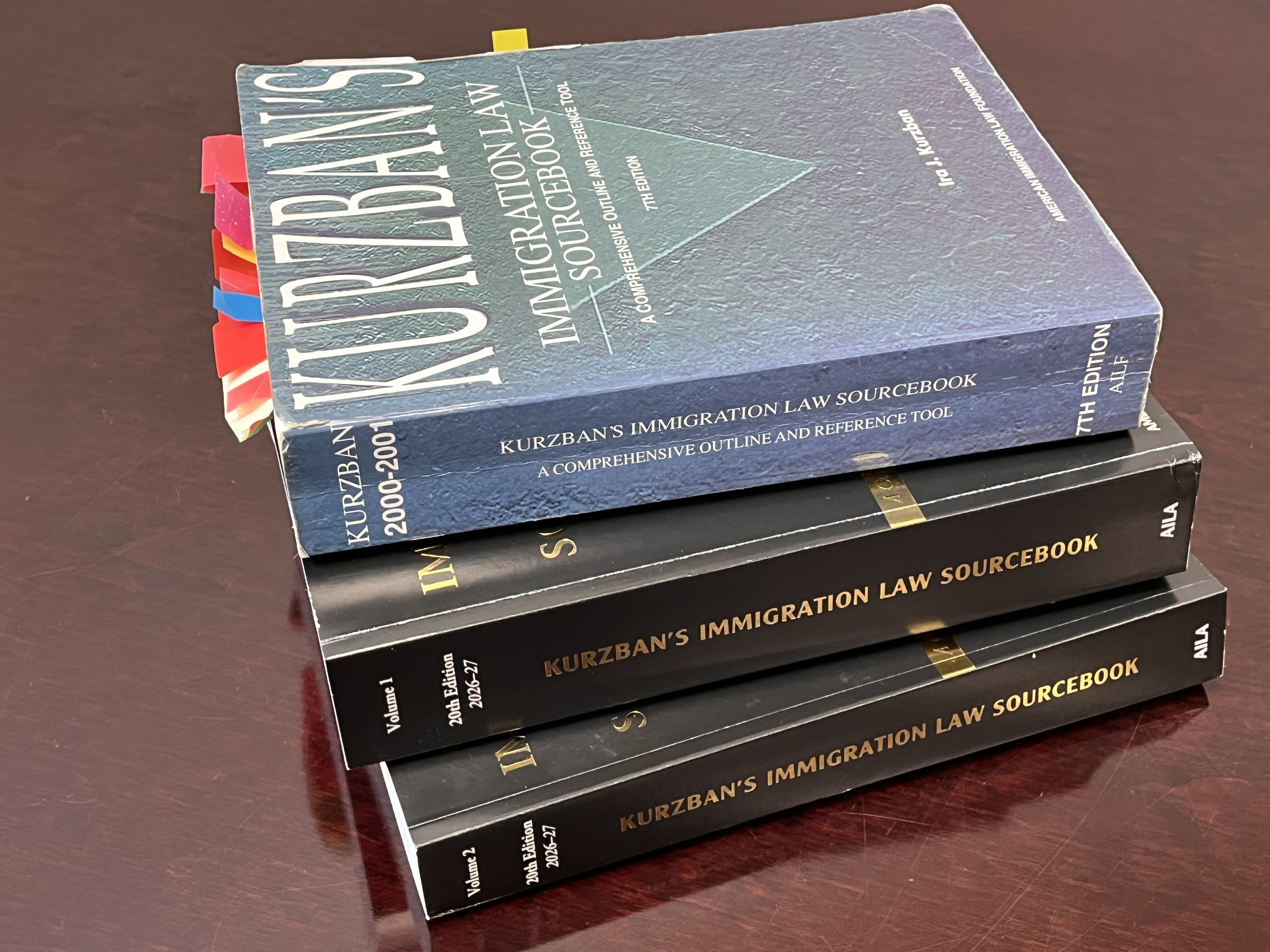
There are many things one expects to accumulate or shed after practicing immigration law for more than a few decades: gray hair or lack thereof, unanswered letters and missives, old forgotten petition approvals or lack thereof, and a healthy dose of distrust of the words “USCIS discretion.”
And then there is Kurzban’s Immigration Law Sourcebook.
I have been buying and using this book since at least 2000.
Twenty-six years later, I find myself once again welcoming the newest edition into my office with the same enthusiasm I had for it all those years ago. That may sound strange. After all, this is not a crime novel, a coffee-table book, or even a page-turner that someone reads for pleasure during these lazy end-of-summer afternoons. It is a book about immigration law. And yet, there is something almost comforting about it.
The first edition appeared in 1990, and over the years the tome has grown along with the immigration beast it attempts to tame. The newest, 20th anniversary edition, has now expanded into two volumes and almost 3,500 pages. That is as intimidating as it sounds. But here is the remarkable part: the writing remains sharp, practical, and concise. That is exactly what Ira intended, as he explains in the book’s preface:
“Although we are fortunate in the immigration field to have a number of outstanding treatises and in-depth reference materials, as a practitioner, I was often frustrated by their lengthy explanations when all I sought were short citations to relevant cases and materials.”
Kurzban’s genius has always been taking a question or doubt that seems to require a congressional committee, three federal courts, and several gallons of coffee—and making the search for an answer feel as familiar and comforting as twisting the lid off a jar of peanut butter. You open your Kurzban’s, turn a few pages, and somehow the problem begins to look manageable. It may not give you the final answer, but it almost always tells you where to start.
I have recommended this book to virtually every lawyer and colleague with whom I’ve worked. It is one of those rare professional references that starts out as a book on your shelf and, before you know it, becomes a colleague at your elbow, a quiet, dependable presence that you reach for whenever a question begins to nag at you.
And yes, I know we are living in the age of AI-enabled search engines, electronic libraries, and screens that can find a case before you have finished typing its name. AILA even offers digital access to the Sourcebook through AILA Link.
But I still want the book.
I want to enjoy being able to turn the pages and smell the ink. There is something about opening the physical volume (now, volumes), flipping through the pages, and finding an old note you scribbled in the margin twenty years ago! Sometimes the page you went looking for is not the page that teaches you something. The book seems to say, “Since you are here, let me show you something else,” or “Did you know that…” and all of the wonderful parenthetical suggestions and hints that allow you to learn and grow as a practitioner.
That is the magic of a well-used reference book. Something that I have come to enjoy over the years.
The margins become somewhat of a history, a record of your own professional life. A question about a difficult matter. A citation that saved you. A regulation, now consigned to the dustheap of history, but that you used oftentimes to argue a certain point. A note scrawled late at night that is illegible and makes absolutely no sense when you rediscover it 15 years later, all of which are why the book to me is a companion as much as it is a physical object.
The digital version can retrieve exactly what you search for. The physical book lets you encounter everything before and after that answer, including material you did not know you needed.
Of course, none of this would be possible without Ira Kurzban and the small army of researchers, editors, and contributors who have helped build and maintain this extraordinary work. Immigration law has, these past few years, changed so much and continues to evolve…challenging us every day to stay current, or be reminded by the client that we have yet to catch up.
And yet the Sourcebook keeps evolving. The 20th anniversary edition incorporates more than 1,000 new cases and developments through the 2025–26 Supreme Court term, among many other updates.
For that, we immigration lawyers owe Ira Kurzban and his colleagues a considerable debt of gratitude.
So, here I am in 2026, twenty-something years after first acquiring my copy, happily shelving another edition.
Two volumes. Thousands of pages. Countless citations. And, I suspect, plenty of new margin notes.
Some people collect wine. Some collect art. Immigration lawyers collect editions of Kurzban’s.
And honestly, I wouldn't have it any other way.
About the Author:
