
Policy Brief: Americans Want Safe Communities, Not a Dangerous and Costly Deportation Agenda
Contact: Greg Chen (gchen@aila.org); Amy Grenier (agrenier@aila.org); Joshua Rodriguez (jrodriguez@aila.org)
In its first year, the current Administration’s mass deportation campaign brought chaos and violence to American communities and undermined public safety. The deaths of over 40 immigrants in federal custody, the wrongful detentions and shooting deaths of U.S. citizens, the arrests of grandfathers dropping off their grandchildren at church or school, and other dangerous actions by DHS personnel are not isolated incidents but symptoms of a systemic problem. Beyond the human toll, the enforcement campaign has also cost American taxpayers tens of billions of dollars and diverted thousands of law enforcement officers from investigating drug trafficking, terrorism, and other serious crimes, raising concerns about whether DHS is properly focused on public safety and national security.
Americans want immigration laws enforced in a humane and effective manner that establishes order. Polls show Americans want Congress to restore public safety and rein in ICE. 65% of Americans disapprove of how ICE is enforcing immigration laws, and 62% of Americans believe ICE is reducing Americans’ safety. This extends across party lines, with a recent poll finding that 77 percent of former Trump voters believe the administration is focusing too much on deportations and not enough on the economy, inflation, and the cost of living.
At this critical moment, Congress has an opportunity to exercise leadership by insisting on reforms that ensure both public safety and humane, lawful enforcement—something Republicans and Democrats can agree on. A better way forward starts with commonsense strategies that prioritize immigration enforcement against people convicted of violent crimes who pose threats to public safety, not people who have jobs and families and have become members of their communities.
DHS Is Spending Unprecedented Amounts of American Taxpayer Dollars on Immigration Enforcement
Immigration enforcement costs money, but taxpayer dollars do not need to be spent recklessly in its pursuit. With the passage of the One Big Beautiful Bill Act (OBBBA), ICE received $75 billion to ramp up its immigration enforcement operations across the country on top of its $10 billion annual base budget. With a ballooning budget, ICE has more funding than all other federal law enforcement agencies combined.
- The increase in funds triples ICE’s annual budget if spent evenly over four years.
- $45 billion of these funds is earmarked to build new detention facilities, including for family detention, and could increase detention facility capacity to 125,000 beds.
- 73 percent of the people detained by ICE do not have a criminal conviction. Keeping them detained costs taxpayers over $8.4 million per day.1
- Nearly $30 billion is dedicated to hire 10,000 more ICE agents, expand ICE’s deportation operations, and hire more ICE attorneys.
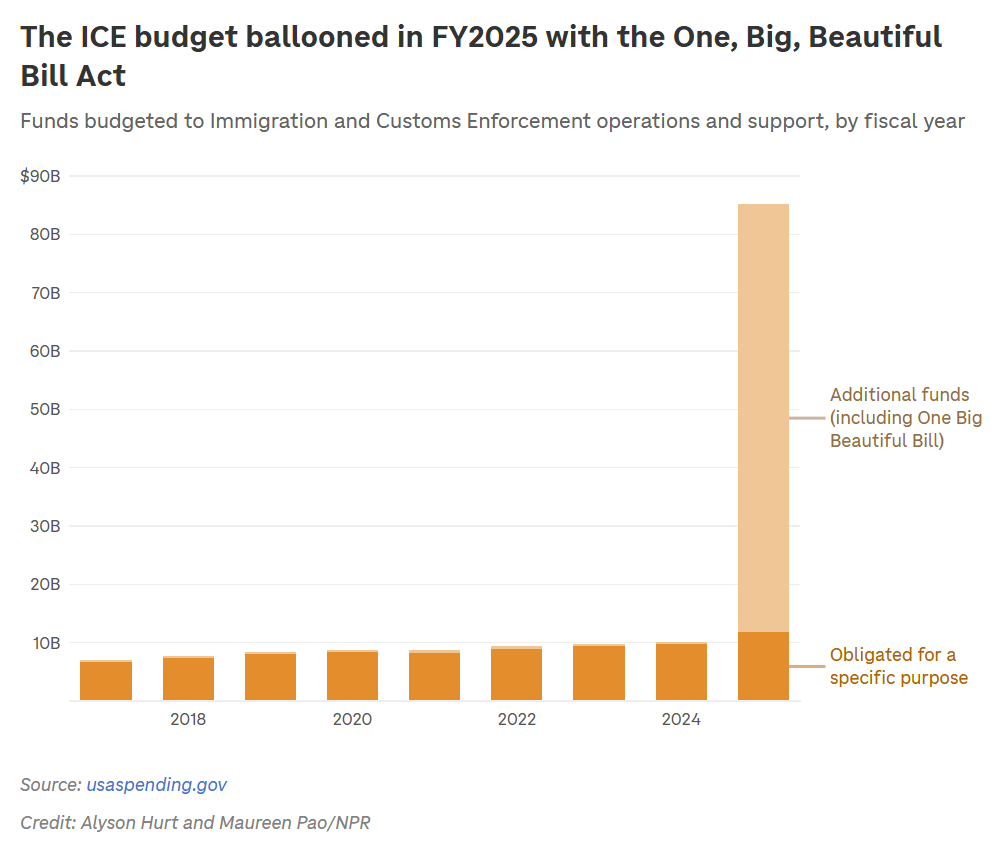 |
| Source: How ICE became the highest-funded U.S. law enforcement agency: NPR |
The U.S. government estimates it costs an average of $17,121 to deport someone. In addition, DHS is expending massive resources to deploy large operations involving hundreds—and even thousands—of agents into U.S. cities. For example, the government spent approximately $234 million to deploy thousands of ICE and other agents to Minneapolis for 13 weeks2 and $59 million for more than two months in Chicago. ICE’s practice of moving people long distances to detention facilities also comes at significant cost. For example, a standard charter flight averages $8,577 per flight hour, regardless of how many migrants are on the plane. ICE chartered 14,426 flights in the first year of the Administration.
Unlawful arrests and errors are hurting people and costing American taxpayers millions. Every time the Administration erroneously detains someone, defies a court order, or advances a baseless legal theory, it imposes unnecessary costs on the courts and government prosecutors as well as the people who are directly harmed. At least 20,000 federal lawsuits have been filed on behalf of immigrant detainees since this Administration began—those federal cases are separate from immigration court removal hearings. Every one of them must be litigated by a government attorney—whose salaries cost money, and whose time is taken away from litigating other government priorities.
A Better Way Forward
- Increase compliance with the law instead of costly, mass deportations. The immigration system needs a broader range of options to enforce immigration law as alternatives to an expensive deportation campaign. Most reform proposals have focused on two options for people who are undocumented: while the law requires that people who have convictions for violent offenses be barred from legal status and deported, Americans broadly agree that those who have lived in the country for years, who have families and jobs and no significant criminal history, should be offered a path to permanent legal status. In between these options, the law should also offer alternatives that allow people to register, live, and work in the U.S. for a short period, after which many would be required to depart. Others could be eligible for permanent legal status through available legal pathways. Such a system would increase compliance with the law and obtain more effective results than the costly and inhumane mass deportation plan.
- Use detention only when justified under the law and under safe conditions. Detention should only be used when necessary and legally justified. Congress should require ICE to demonstrate to the immigration court that a person is a flight risk or a threat to public safety in order to detain them. In addition, enforceable standards should be codified to ensure humane treatment and the proper provision of food, medical treatment, access to legal counsel and family, and other necessary services. Congress should continue to have the authority to conduct oversight visits of detention facilities at any time and without advance notice. Funding for family detention should be ended to stop the jailing of families and children, such as 5-year-old Liam Conejo Ramos and his father. Finally, Congress should strip out the $45 billion the OBBBA provided for detention.
Immigration Enforcement Should Prioritize Serious Threats, Not Lawful Immigrants
Immigration enforcement is not currently focused on removing dangerous criminals. Contrary to the President’s claims, data shows DHS is not focusing on the “worst of the worst.” Indeed, less than 14% of the nearly 400,000 immigrants ICE detained in the Administration’s first year in office had charges or convictions for violent crimes. Almost 40% of those arrested by ICE did not have any criminal record at all.
Nationwide, every other law enforcement agency sets priorities and exercises prosecutorial discretion when choosing which individuals or incidents to pursue. Instead of prioritizing immigration enforcement against criminal actors who pose a public safety threat, the Administration uses a dragnet approach that includes imposing arbitrary quotas of arresting 3,000 people per day on ICE and CBP.
- DHS is targeting, re-adjudicating, and detaining lawful immigrants. The Administration is going after people with legal immigration status, resulting in a high number of improper detentions and removals of people who should not be subject to enforcement at all. Pursuing people living and working legally has a significant economic cost, causing labor shortages and lost productivity for U.S. businesses.
- The Administration is needlessly re-reviewing approved visas, naturalizations, and other applications, likely impacting tens of millions of cases. Re-adjudicating these cases diverts resources from processing the over 11 million immigration benefit applications that are currently awaiting decisions. This massive effort could strip more than 2 million people of their current work authorization. Compounding this folly, ICE is unnecessarily arresting and detaining lawful immigrants while it re-examines their cases, imposing severe hardship.
- In the past year, the Administration has wrongfully detained 170 U.S. citizens, including pregnant women. By law, ICE does not have the authority to detain U.S. citizens. ICE could avoid these erroneous detentions with proper screening and more targeted enforcement strategies.
- ICE has started detaining refugees if they did not apply for green cards within a year. Refugees not only have legal status but are rigorously vetted through security checks that take years. ICE targeted 5,600 refugees living in Minnesota for arrest, sent many far away to Texas for detention, and then released them on the streets in Texas with no support after confirming their refugee status.
- ICE is pursuing children who are eligible for green cards. Jamie, whose story was told in Newsweek, received special protection as a child victim of abuse or neglect making him eligible for a green card. Despite having a valid work permit, he was picked up in an ICE raid and was detained for 58 days, costing over $11,000 in detention alone.
ICE is indiscriminately detaining thousands of people with no valid basis, frequently in direct violation of the law and court orders.
- ICE is illegally detaining people. Federal judges are ruling that mass detentions violate the law. Since October 2025, more than 400 federal judges have ruled at least 4,421 times that ICE is holding people illegally. Not only are the detentions unlawful, but at nearly $190 per person per day, these detentions cost the taxpayer about $840,000 per day.
- ICE and the immigration courts are denying bond to people without review. Despite longstanding legal principles and precedent authorizing immigration courts to review people’s requests to be released from detention, the Administration announced that courts no longer have authority to do this, resulting in unnecessary and costly detentions.
A Better Way Forward
- Restore public trust in the system by codifying enforceable standards to ensure safe, humane, lawful immigration enforcement. Americans expect ICE and CBP to respect the Constitution and rule of law. No other federal, state, or local law enforcement operates above the law. Decades of smart policing practices have established standards with consequences grounded in the 4th Amendment, such as exclusion of evidence and case dismissal. At a minimum, Congress should mandate warrants for arrests and entry into private property, halt racial and other impermissible profiling, and prohibit enforcement in schools, churches, and other sensitive locations. See AILA’s detailed recommendations.
- Prioritize who should be targeted for immigration enforcement instead of indiscriminately detaining people to meet quotas. Republicans and Democrats widely agree that DHS should focus on people who are dangerous and have convictions for violent crimes rather than people with minor violations of law who have families and jobs and no history of convictions. As with the national security and law enforcement fields, the successful and effective enforcement of immigration law requires prioritization that focuses on quality rather than quantity. Congress should codify priorities based on public safety, national security, border security, and severity of criminal offenses.
- Establish robust oversight to ensure accountability and compliance with the rule of law in the immigration system. Congress should establish an independent oversight body with investigatory and subpoena powers to prevent ICE, CBP, and other federal agent abuses and hold them accountable. Congress made a grave mistake by giving DHS an unprecedented $170 billion blank check in the OBBBA. It should reduce that funding and impose restrictions and accountability measures on how the remaining money is spent.
The Administration’s Focus on Immigration Enforcement Drains Resources from Other Law Enforcement Agencies and Compromises Public Safety
Over the past year, the Administration has re-assigned more than 13,000 federal law enforcement officers from other agencies to immigration enforcement. Each diverted federal law enforcement agent is no longer contributing to their agency’s mission. Former ICE chief of staff Jason Houser testified to Congress that “[s]creening, inspection, and interdiction suffer” now that CBP officers are being “used to chase landscapers and line cooks 1,000 miles from the nearest border.”
- Nearly one in five FBI agents no longer focus on their mission of protecting the American people from the “most dangerous threats” including terrorists, child predators, and serial killers.
- About half of Drug Enforcement Agency (DEA) agents no longer enforce the controlled substance laws of the United States, such as preventing fentanyl trafficking.
- 63 percent of Bureau of Alcohol, Tobacco, Firearms, and Explosive agents no longer target violent crime and the illegal use of firearms and explosives.
- A whopping 87 percent of Homeland Security Investigations officers no longer investigate drug and weapons smuggling, child exploitation, and human trafficking.
- Border Patrol officers who used to ensure drugs did not cross the border were dispatched to the interior to arrest undocumented workers who are not likely to be criminals, leaving highway checkpoints in prominent fentanyl trafficking routes unstaffed.
- At least 796 Coast Guard flights were redirected from their missions supporting maritime law enforcement and security to immigration enforcement since June 2025.
- Federal drug prosecutions have dropped to a historic low.
Finally, state and local law enforcement will likely see a decrease in the reports of community reports of criminal activity, as ICE continues to arrest people who report crimes. Law enforcement officers have argued for years that indiscriminate immigration enforcement also has a negative impact on their ability to fight crime.
Conclusion
The Administration’s immigration enforcement agenda has unleashed violence and imposed enormous costs on the American public in both tax dollars and the erosion of public safety. Americans want safe, orderly communities. That can be achieved by setting clear priorities for immigration enforcement that increase compliance with the law. To restore the public’s trust and confidence, enforceable standards must be codified to stop the unlawful, unconstitutional and dangerous actions being committed by federal agents. Compliance with immigration law can be achieved more efficiently by reducing the use of detention and targeting violent offenders rather than people who are not threats to public safety. Similarly, returning federal law enforcement officers and resources to focus on their agency’s original mission will keep Americans safer from violent threats.
Read the other policy briefs in this series, A Better Way on Immigration.
1 44,882 people without a conviction at an average of $187.48 per day.
2 Figure based on $18 million a week for 13 weeks.